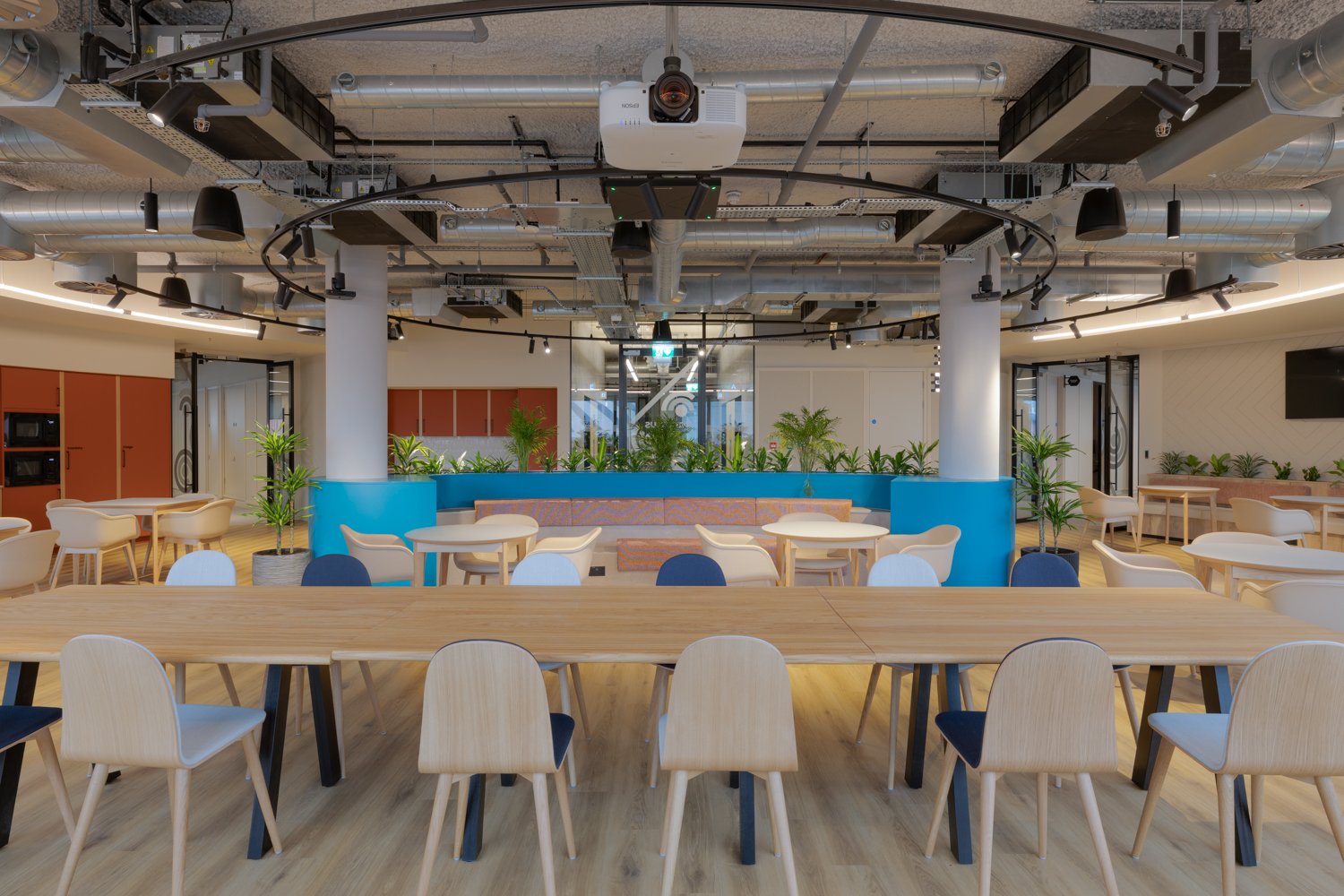
Delivering Office Fit Outs in Highly Regulated Financial Environments
Delivering Office Fit Outs in Highly Regulated Financial Environments
In financial services, the workplace functions as an operational system rather than a passive setting. Every spatial, technical and security decision is shaped by regulation, data governance and the need for uninterrupted performance.
As a result, office fit-outs for banks, insurers and capital markets firms are fundamentally different from standard workplace upgrades. These projects carry operational, regulatory and reputational risk, and must perform within tightly interconnected environments where failure is not an option.
At DENTON, we have delivered complex workplace projects for financial and professional services organisations since 1996. Our role extends beyond construction. We help clients navigate regulatory complexity, safeguard business continuity and deliver resilient environments aligned to long-term strategy.
Regulation as a Design Driver
Regulation now shapes every aspect of financial workplace design. Standards such as MiFID II, GDPR, and global financial controls are no longer administrative checkboxes; they are active design drivers that dictate spatial layouts, access control, and infrastructure planning.
A fit-out informed by regulation anticipates operational realities rather than retrofitting compliance later. This includes:
- Secure separation of teams and risk profiles to mitigate operational exposure
- Controlled and auditable data movement through spatial and technological measures
- Resilient IT and M&E infrastructure that supports continuous operations
- Clear lines of access, visibility, and governance to satisfy compliance and oversight requirements
- Flexible zoning within compliant frameworks that can evolve as teams, processes, and regulatory requirements change
- Infrastructure built for future adaptation, including IT, M&E, and secure data handling
- Phased delivery programmes that maintain live trading floors, client services, and critical operations without disruption
- Careful sequencing around business-critical functions to minimise operational risk
- Close coordination with IT, security, and compliance teams, ensuring every design and construction decision protects performance and data integrity
When regulation is treated as a foundational design input, workplaces remain compliant, flexible, and efficient even as rules evolve.
ESG as a Core Requirement
Environmental, Social and Governance considerations are no longer supplementary in financial sector fit-outs. In highly regulated environments, ESG is a fundamental operational requirement, shaped by regulation, investor scrutiny, and internal risk governance. It must be embedded from the earliest stages of design, rather than added retrospectively to satisfy compliance.
From an environmental perspective, this means addressing both operational and embodied carbon through material selection, energy systems, retrofit strategies, and services planning. These choices are no longer “nice-to-have” sustainability initiatives. They directly influence asset value, compliance, and long-term operating costs.
The social dimension is equally critical. Workplaces must foster wellbeing, accessibility, and inclusivity while maintaining security and operational performance. Elements such as layout, lighting, acoustics, and environmental quality all affect productivity, resilience, and talent retention in high-pressure financial roles.
Governance ties these strands together. Transparent decision-making, auditable processes, and documented ESG outcomes are essential in sectors where accountability is non-negotiable. Fit-outs that integrate ESG frameworks from day one reduce regulatory risk while reinforcing corporate responsibility and investor confidence.
As Giuseppa Fiorenza, Head of Sustainability & Environment at DENTON, explains:
“In regulated financial environments, ESG is often treated as a reporting obligation. In reality, it is a resilience issue. Decisions about materials, energy systems and spatial strategy directly affect security, operational stability and the ability to adapt to future regulation. If those choices are wrong, risk increases, not decreases.”
Richard Douglas, Director at DENTON, adds:
“We see many projects where ESG is addressed late, usually to satisfy compliance. That approach creates friction. When sustainability is embedded early, it reduces rework, avoids conflicting standards and supports the governance structures financial institutions already operate within.”
By treating ESG as a core operational requirement rather than a design ambition, financial organisations can deliver workplaces that are secure, auditable, resilient, and genuinely future-ready, rather than spaces patched together to meet yesterday’s standards.
Designing for Complexity and Ensuring Operational Continuity
Financial workplaces are inherently complex, operating under intense regulatory oversight, high-speed transactions, and sensitive client interactions. Attempting to impose certainty through rigid layouts or one-size-fits-all designs often create fragility rather than control. The more effective approach is to design for adaptability while safeguarding operational continuity, anticipating change in regulation, technology, and organisational structure.
At DENTON, we apply a precision-driven approach that balances flexibility, compliance, and live operations. This includes:
By integrating adaptability with continuity, organisations gain agile, resilient and responsible workplaces that maintain operational integrity, regulatory compliance, and staff productivity. This methodology has successfully supported complex projects for clients including MUFG, QBE, and Eight Advisory, where trust, discretion, and accuracy are paramount.
In other words, a high-performing finance office is not just a static space - it is a dynamic operational system designed to navigate uncertainty, support people, and enable business-critical activity under pressure, using techniques like cut & carve to deliver precision interventions without compromise.
Secure, Data-Led Environments
In financial services, data security is not confined to servers and software. It is shaped just as much by physical space, movement and visibility. Secure office fit-outs must therefore integrate spatial planning, technology and behavioural design to protect sensitive information without undermining usability or performance.
Effective secure environments are built around clear zoning strategies that separate public, client-facing and high-security areas.
Circulation routes, access points and sightlines are deliberately controlled to minimise risk, while ensuring teams can operate efficiently within their designated zones. Infrastructure, from power and cabling to AV and storage, is designed to support secure data handling and regulatory compliance from the outset.
Crucially, security must be embedded early in the fit-out process. When treated as an afterthought, it often leads to restrictive layouts, costly rework and compromised user experience. When integrated from the discovery and design stages, security becomes an enabler of performance rather than a constraint.
DENTON’s experience delivering secure office fit-outs for financial and professional services clients demonstrates that well-designed security supports operational flow, protects sensitive activity and aligns seamlessly with ESG and governance requirements. The result is a workplace that safeguards data, supports people and withstands the scrutiny of a regulated environment.
Fit-Outs for a Turbulent Environment
The financial sector operates in a turbulent, uncertain, novel and ambiguous environment. In this context, successful fit-outs are defined by resilience rather than aesthetics. The workplaces that endure will be those designed to adapt, protect operations and support people under pressure.
At DENTON, we believe effective fit-outs do not attempt to simplify complexity. They are designed to navigate it. If you are planning an office transformation within a regulated financial environment and want to partner with a fit-out company with proven expertise - get in touch.